Modified tapioca starch – a cost-effective solution for the sausage manufacturing industry.
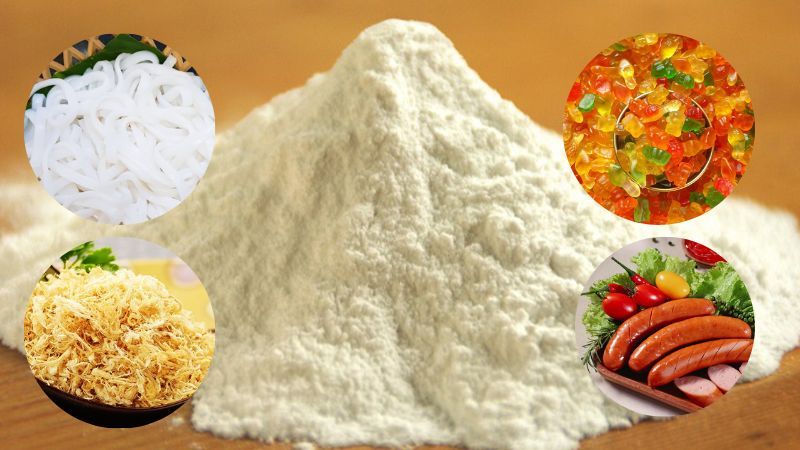
In the industrial sausage processing industry, the pressure to optimize raw material costs is always one of the most important factors determining a manufacturer's competitiveness. Meat prices often account for a large proportion of total production costs and are always fluctuating with the market, so factories are always looking for technological solutions that can reduce costs while maintaining the structure and sensory quality of the product. In this context, modified tapioca starch has become one of the functional ingredients widely used in the sausage industry globally, not only as an additive but also as a tool to effectively optimize production formulas.
1. The Role of Meat in Sausage Structure
In emulsion sausage products, meat plays a core role in forming the product's structure. Muscle fiber proteins like myosin and actin, when ground and heated, form a protein gel network that stabilizes the emulsion, retains water and fat, and creates the elasticity and characteristic structure of sausage. This protein network is what gives sausage its "real meat" feel, chewiness, and smoothness that consumers expect.
A typical sausage production formula in industry usually has the following structure:
Ingredients Ratio
Meat 55 – 75%
Water/Ice 15 – 25%
Fat 10 – 20%
Additives (starch, soy protein, phosphate, etc.) 2 – 8%
In terms of raw material costs, meat usually accounts for 70 – 85% of the total cost. Therefore, even a small reduction in the meat ratio in the formula can make a significant difference in profitability in industrial-scale production.
2. Modified Cassava Starch and Why It's Suitable for Sausages
Modified cassava starch is starch that has been processed using physical or chemical methods to improve its technological properties compared to natural starch. The modification process gives the starch higher heat resistance, increased water retention, stability during freezing and thawing, and resistance to strong mechanical shear forces during emulsion mixing.
Compared to natural cassava starch, modified starch offers superior performance in processed meat products, especially sausages.
Characteristics Natural Starch Modified Starch
Thermal Stability Low High
Water Separation After Sterilization Easy Limited
Gel Strength Medium Medium-High
Emulsion Stability Low Good
Thanks to these characteristics, modified cassava starch helps maintain a stable sausage structure during steaming or sterilization at high temperatures, limiting water separation and helping the product retain a smooth, elastic structure after processing.
3. Mechanism for Reducing Meat Ratio
Modified cassava starch optimizes sausage formulations through three main mechanisms: increasing water retention, improving emulsion stability, and supporting the gel structure of the product.
3.1 Increased Water Retention
Modified starch has a very high water absorption and retention capacity. In sausage production conditions, on average, 1 kg of modified starch can retain 3-5 kg of water, depending on the type of starch. This allows manufacturers to increase the water content in the formula while maintaining product structure, thereby reducing the amount of meat needed.
Example of formula modification:
Ingredients | Traditional Formula | Optimized Formula |
|---|---|---|
Meat | 70% | 60% |
Water | 20% | 25% |
Starch | 2% | 5% |
The result is that the meat content can be reduced by approximately 10% while the total weight and product structure remain stable.
3.2 Improving Emulsion Stability
During sausage grinding and mixing, modified starch helps increase the viscosity of the emulsion system, thereby stabilizing the dispersion of fat and reducing protein shrinkage upon heating. Thanks to this effect, the product maintains its smoothness, elasticity, and stable structure even when the amount of animal protein in the formula is reduced.
3.3 Gel Structure Support
Some types of modified starch, such as cross-linked starch or acetylated starch, have the ability to form a soft and elastic gel when heated. This starch gel acts as a support network, combining with the protein gel network of the meat to create a stable sausage structure. As a result, the product retains the desired firmness and smoothness without becoming crumbly or powdery when the meat ratio is reduced.
4. Meat Reduction Levels in Actual Production
Depending on the product segment and market strategy, manufacturers may apply different meat reduction levels.
Segment | Starch Ratio | Meat Reduction |
|---|---|---|
High | 2 – 3% | 3 – 5% |
Midium | 3 – 5% | 5 – 10% |
Standard | 5 – 8% | 10 – 15% |
However, if the starch ratio exceeds 8%, the product may exhibit structural problems such as powderiness, reduced elasticity, and a decline in meat flavor.
5. Economic Benefits for the Factory
One of the key reasons why modified cassava starch is widely used in the sausage industry is its clear economic benefits.
Assuming the average market price of raw materials:
Meat price: 80,000 VND/kg
Modified starch price: 18,000 VND/kg
If the meat content in 1 ton of sausage is reduced by 10%, the cost could change as follows:
Meat cost savings:
100 kg × 80,000 = 8,000,000 VND
Additional starch cost:
30 kg × 18,000 = 540,000 VND
Net economic benefit of approximately VND 7,460,000 per ton of product.
For a large-scale production plant, for example, 1,000 tons per month, this level of savings can generate very significant additional profits in the long term.
6. Xu hướng công nghệ trong ngành xúc xích
Hiện nay, các nhà sản xuất xúc xích trên thế giới đang theo đuổi hai xu hướng chính. Trong phân khúc phổ thông, việc tối ưu chi phí nguyên liệu bằng cách sử dụng tinh bột chức năng là giải pháp phổ biến nhằm giữ giá thành cạnh tranh. Trong khi đó, phân khúc cao cấp tập trung vào việc cân bằng giữa cấu trúc, giá trị dinh dưỡng và nhãn mác sản phẩm, bao gồm xu hướng clean label, trong đó ưu tiên sử dụng tinh bột biến tính vật lý thay vì tinh bột biến tính hóa học. Xu hướng này đang được áp dụng rộng rãi tại các thị trường phát triển như châu Âu, Hoa Kỳ và Nhật Bản.
7. Kết luận
Trong ngành sản xuất xúc xích hiện đại, tinh bột sắn biến tính không chỉ là một phụ gia thực phẩm mà còn là một giải pháp công nghệ giúp tối ưu hóa công thức và giảm chi phí sản xuất. Khi được sử dụng đúng loại và đúng tỷ lệ, tinh bột có thể giúp giảm tỷ lệ thịt từ 5 – 15% mà vẫn duy trì cấu trúc, độ đàn hồi và cảm quan của sản phẩm. Điều này mang lại lợi ích kinh tế đáng kể cho các nhà máy sản xuất quy mô lớn, đồng thời giúp doanh nghiệp duy trì khả năng cạnh tranh trong bối cảnh giá nguyên liệu ngày càng biến động.
Secure Your Supply with Confidence
We support buyers with stable sourcing by working closely with local partners and managing controlled processing systems to ensure consistent supply.
Contact Us



Phone Number


Zalo