Application of modified cassava starch in sausage processing and its impact on meat ratio.
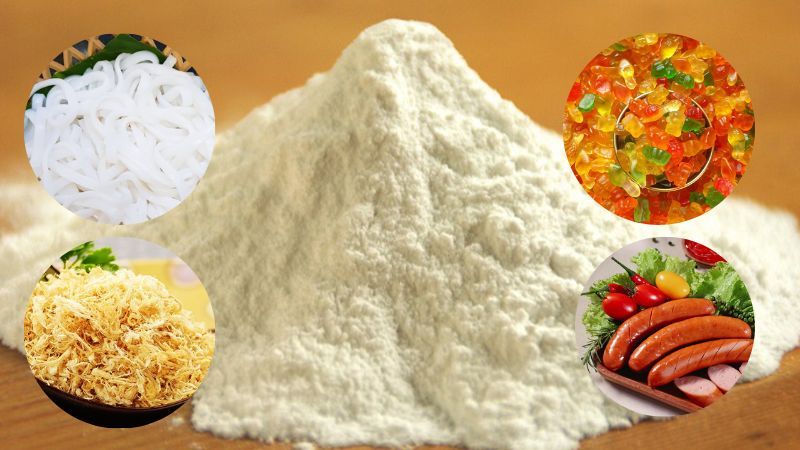
In the meat processing industry, especially for sausage production, the biggest challenges for manufacturers always revolve around raw material costs, product structure, profit margins, and consumer perception. In the context of volatile meat prices and increasing competition, the use of modified tapioca starch is becoming a popular technical and economic solution.
1. The Role of Meat in Sausage Structure
In emulsion sausage, meat plays the following roles:
Provides myofibrillar proteins (myosin, actin)
Forms a gel network upon heating
Retains water and fat
Provides elasticity and characteristic structure
Typically:
Meat ratio: 55–75%
Water/ice: 15–25%
Fat: 10–20%
Additives (starch, soy protein, phosphate, etc.): 2–8%
The problem is: meat accounts for 70–85% of the total raw material cost.
2. What is Modified Tapioca Starch and Why Is It Suitable for Sausages?
Modified tapioca starch is starch that has been physically or chemically treated to improve:
Heat resistance
Water retention
Freezing and thawing stability
Mechanical stability during grinding and mixing
Compared to native tapioca starch, the modified type has:
Native Modified Characteristics
Stability at high temperatures Low High
Water separation after sterilization Easy Limited
Gel strength Medium High
Meat substituteability Limited Good
In sterilized (retort) or high-temperature steamed sausages, only modified starch ensures a structure that is not porous, crumbly, or water-separated.
3. Mechanisms for Reducing Meat Content
Modified cassava starch helps reduce meat content through three main mechanisms:
Increased Water Binding Capacity
1 kg of modified starch can hold:
3–5 kg of water (depending on the type)
When adding 3% starch:
This can increase the water content in the formula by 6–12%
This means a corresponding reduction in the meat content.
Example:
Traditional Formula Optimal Formula
Meat 70% Meat 60%
Water 20% Water 25%
Starch 2% Starch 5%
=> Reduces meat content by 10% while maintaining product weight.
Improved Emulsion Structure
Modified starch:
Increases paste viscosity
Stabilizes fat dispersion
Reduces syneresis
This allows:
Reducing animal protein without making the sausage crumbly. 3.3 Creating a "mouthfeel" effect equivalent to meat
The appropriate type of starch (cross-linked, acetylated, etc.) creates a soft, elastic, and smooth gel, resulting in:
Retaining a chewy texture
Not being powdery
Not being too hard
4. What is the actual meat reduction level?
Varies depending on the product segment:
🔹 Premium segment
Meat reduction: 3–5%
Starch: 2–3%
🔹 Mid-range segment
Meat reduction: 5–10%
Starch: 3–5%
🔹 Mainstream segment
Meat reduction: 10–15%
Starch: 5–8%
Note: Exceeding 8% starch can cause:
A powdery texture
Reduced elasticity
Loss of natural meat flavor
5. Economic analysis: Why is the business implementing this?
Assumptions:
Meat price: 80,000 VND/kg
Modified starch price: 18,000 VND/kg
Reducing meat by 10% (100 kg per 1-ton batch):
Savings:
100 kg × 80,000 = 8,000,000 VND
Additional starch cost (30 kg):
30 × 18,000 = 540,000 VND
→ Improved profit ~ 7,460,000 VND/ton
In large-scale production:
1,000 tons/month → enormous difference.
This is why modified cassava starch is widely used globally.
6. Risks of Abuse
Despite economic benefits, abuse causes:
Loss of natural firmness
Reduced meat flavor
Pockmarked cross-section
Reduced declared protein content
Risk of violating national standards
In Vietnam, the minimum meat standard for sausages is clearly stipulated in relevant Vietnamese National Technical Regulations (QCVN).
7. Current Market Trends
Currently:
Low-price segment: increased starch content
High-end segment: reduced starch, increased high-quality plant protein
Clean-label trend: using physically modified starch instead of chemically modified starch
In developed markets such as: Germany, United States, Japan
Manufacturers strike a very tight balance between: Cost saving, Protein declaration,Texture profile
8. Conclusion
The use of modified tapioca starch in sausages can reduce the meat content by 5–15%, depending on the product segment and strategy.
However:
Reduced meat content ≠ reduced quality if optimized correctly.
Abuse will disrupt the structure and brand image.
Success lies in the balance between protein, water, starch, and sensory appeal.
In the context of fluctuating meat prices and fierce competition, modified tapioca starch is not just an additive, but a strategic cost-optimization tool in the sausage processing industry.
Secure Your Supply with Confidence
We support buyers with stable sourcing by working closely with local partners and managing controlled processing systems to ensure consistent supply.
Contact Us



Phone Number


Zalo